LA's New Adaptive Reuse Ordinance: 50 Million Square Feet of Opportunity
Los Angeles just made one of its most consequential housing policy moves in decades — and it has nothing to do with new construction.
The Citywide Adaptive Reuse Ordinance, approved by the City Council in January and now in effect, dramatically expands where and how underused commercial buildings can be converted into housing. More than 50 million square feet of vacant office space across the city is now eligible for residential conversion, and the streamlined approval process removes months — sometimes years — of entitlement risk.
For investors and developers already tracking the entitlement pipeline, this changes the calculus entirely.
What Changed
The original 1999 Adaptive Reuse Ordinance was a landmark policy that helped transform Downtown LA from a nine-to-five business district into a real residential neighborhood. But it was geographically limited — conversions were restricted to designated areas like Downtown, Chinatown, Hollywood, and Koreatown.The new ordinance removes those boundaries. Key changes include:
Why This Matters for Underwriting
The single biggest shift is certainty. When approvals are predictable, projects can be designed, financed, and phased with far less guesswork.Developers have historically avoided office-to-housing conversions in LA because the entitlement process was unpredictable. A project that penciled at acquisition could easily become uneconomic after 18 months of discretionary review, community opposition, and environmental analysis. The new ordinance largely eliminates that risk for qualifying buildings.
The design flexibility is equally significant:
In practical terms, a developer can take a 1990s-era office building that exceeds today's height district, keep its full floor area, eliminate parking requirements, and add interior light wells — all without a single hearing.
Where the Opportunity Is Concentrated
Office vacancy in Los Angeles is not evenly distributed. The corridors with the highest concentration of eligible buildings include:Many of these buildings were never realistically going to attract post-pandemic office tenants. But until now, converting them meant navigating the full discretionary entitlement process. That barrier is gone.
Stacking With Existing Incentives
The adaptive reuse ordinance does not exist in isolation. The most sophisticated developers will layer it with existing programs:The combination of adaptive reuse streamlining plus incentive stacking creates a pathway that simply didn't exist six months ago.
What the Market Is Already Doing
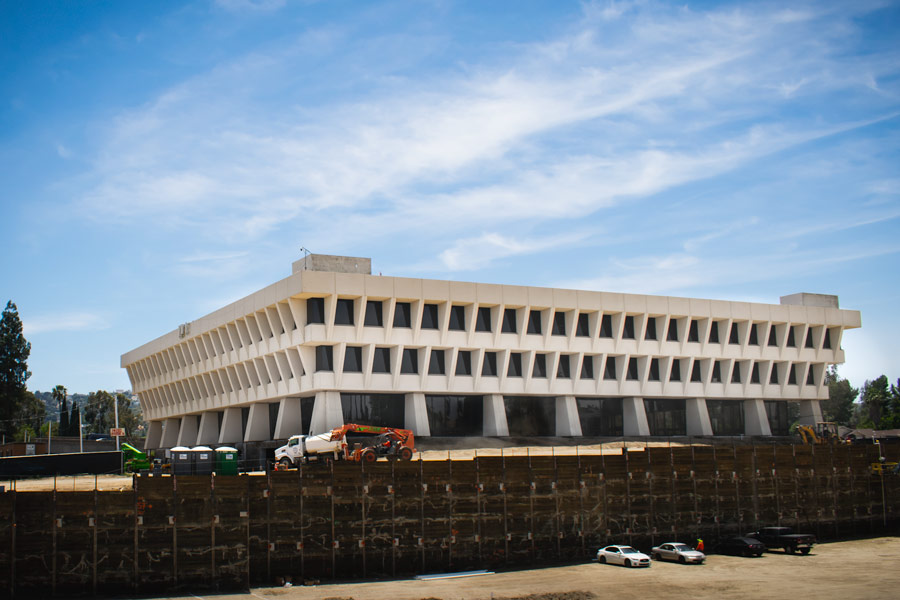
Early movers are not waiting. Jamison Properties has begun converting a long-struggling office high-rise near Downtown into nearly 700 apartments. In Sherman Oaks, IMT Residential is converting the former Sunkist Growers headquarters — a brutalist landmark — into 95 apartments. Los Angeles currently ranks second nationally in adaptive reuse housing development with 5,640 units in progress, roughly half of which are office-to-residential conversions.The rolling 15-year eligibility threshold means that each year, a new wave of buildings will qualify — many of them newer, more efficient, and less burdened by seismic retrofit costs than the pre-1975 stock that drove the first generation of conversions.
Risks to Watch
The ordinance does not solve the economics on its own. Key risks remain:That said, the removal of entitlement risk alone changes the return profile for many buildings that were previously uneconomic to convert.
The Bottom Line
The Citywide Adaptive Reuse Ordinance is the most significant expansion of LA's housing production toolkit since the density bonus reforms. It acknowledges what the market already knows: the office sector has structurally changed, housing demand remains acute, and the fastest path to new homes may not be new construction — but the reinvention of what the city has already built.For investors screening the LA market, every commercial building over 15 years old just became a potential housing site. The question is no longer whether conversion is allowed — it's whether the numbers work. And with the right combination of acquisition basis, incentive stacking, and unit mix, increasingly the answer is yes.
For more on how density bonus, TOC, and other incentive programs are being deployed across the current entitlement pipeline, see our Los Angeles Zoning Trends & Entitlements Report.