Rights Analysis and Distribution: Unlocking Hidden Value in LA Development Sites
In Los Angeles, the right to build is often worth more than the land itself. A one-story strip mall on a lot zoned for 45 feet in height and 3:1 FAR may be producing $50,000 per year in rent — but sitting on $5 million in unused development rights. Understanding how to analyze, value, and strategically deploy those rights is fundamental to maximizing returns in LA real estate.
This guide covers the mechanics of development rights analysis: how rights are created by zoning, how they're calculated, how they can be transferred or combined, and how to think about rights distribution across a portfolio or assemblage.
What Are Development Rights?
Development rights represent the legal capacity to build on a property. In zoning terms, they're the difference between what exists on a site and what the zoning code permits. Every parcel in Los Angeles has a defined development envelope — maximum density, FAR, height, and building coverage — established by its zone classification, height district, and any applicable overlays or specific plans.When a property is built to less than its maximum permitted development, the difference constitutes unused development rights. A 10,000 square foot lot in a C2-1 zone (1.5:1 FAR base) has 15,000 square feet of permitted floor area. If the existing building is only 5,000 square feet, there are 10,000 square feet of unused development rights.
These rights have value because they represent the ability to add rentable or sellable space. In high-value LA markets, that can translate to hundreds of dollars per buildable square foot.
Calculating Development Rights in Los Angeles
LA's zoning code creates development rights through several interacting metrics. A complete rights analysis requires calculating each:Floor Area Ratio (FAR)
FAR is the ratio of total building floor area to lot area. A 10,000 SF lot with 3:1 FAR can support 30,000 SF of building. In LA, FAR is determined by the Height District, which layers on top of the base zone:FAR bonuses are available through density bonus programs, TOC, and other incentives — these effectively create additional development rights beyond base zoning.
Density (Dwelling Units per Acre)
For residential development, density limits the number of units regardless of FAR. An R3 zone permits one unit per 800 SF of lot area. A 10,000 SF R3 lot can have 12 units maximum. Higher-density zones (R4, R5, C2) have lower lot area requirements per unit:Density bonus and TOC can increase permitted units by 50-80% above base density.
Height
Height limits interact with FAR to shape the building envelope. A site might have 6:1 FAR but a 75-foot height limit — meaning you can't build a tower even if FAR would support it. Height is controlled by:Lot Coverage and Open Space
Coverage limits restrict the building footprint as a percentage of lot area. Open space requirements mandate minimum landscape or recreational area per unit. These constraints can limit achievable FAR even when the code permits higher density.The Rights Analysis Process
A complete development rights analysis for an LA property follows this sequence:Step 1: Establish Base Entitlements
Step 2: Calculate Bonus Entitlements
Step 3: Calculate Total Development Capacity
Step 4: Calculate Unused Development Rights
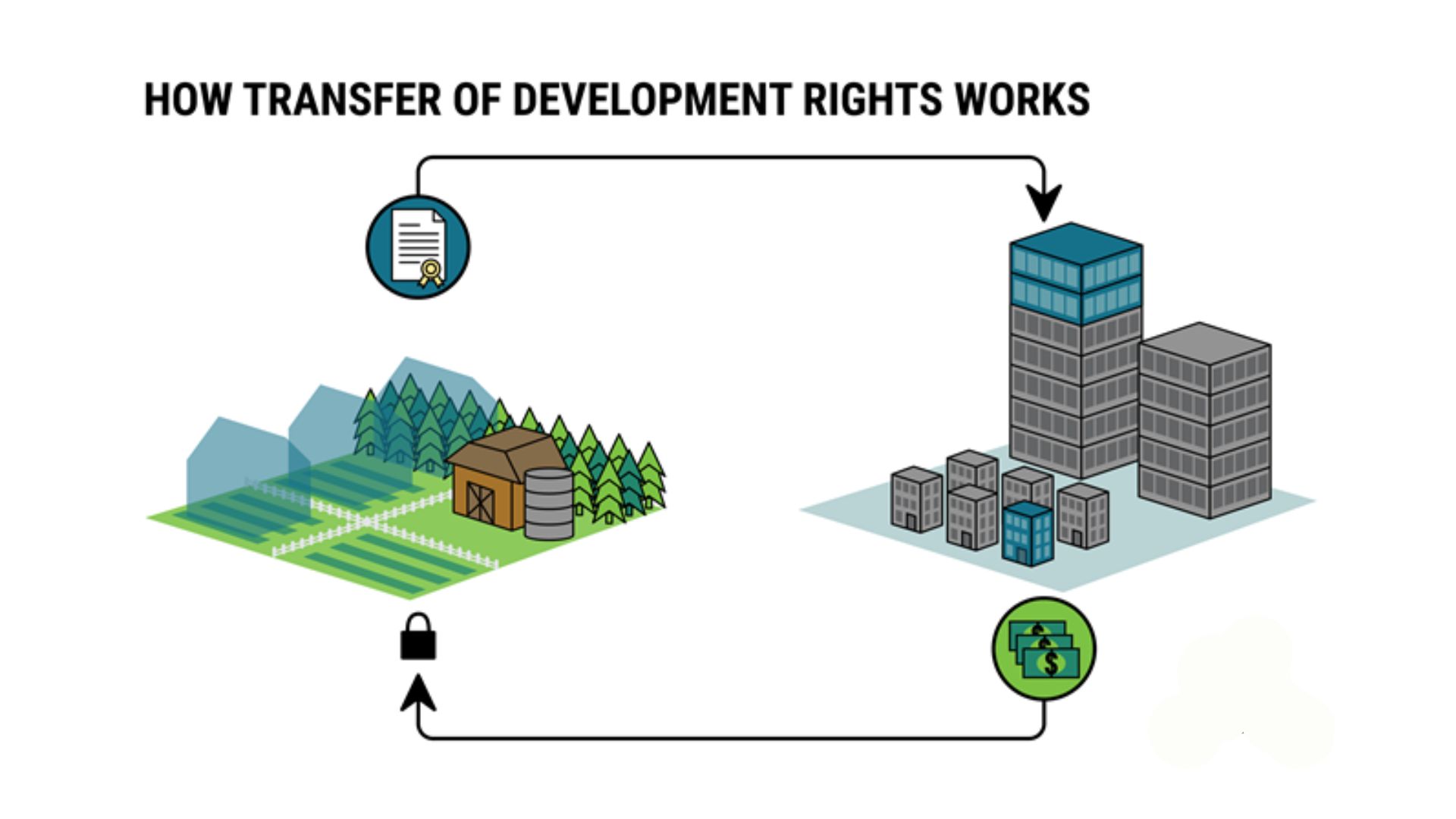
Transfer of Development Rights in Los Angeles
Unlike New York City, Los Angeles does not have a comprehensive citywide Transfer of Development Rights (TDR) program. However, several mechanisms allow for rights transfer or combination:Lot Ties and Lot Line Adjustments
Adjacent parcels can be combined through lot ties, allowing development rights to be aggregated across the combined site. This is the most common method for assemblage deals where a developer acquires multiple parcels to achieve greater development capacity. A lot tie creates a single development site for zoning purposes while maintaining separate legal parcels.TFAR (Transfer of Floor Area Rights) — Downtown LA
The Downtown LA Community Plan includes a Transfer of Floor Area Rights program that allows floor area to be transferred from donor sites to receiver sites within the plan area. This is LA's closest equivalent to NYC's landmark TDR program:Unified Development
Multiple parcels under common ownership or control can be developed as a unified project, distributing density and FAR across the combined site. This allows flexibility in massing — concentrating height on one portion while maintaining lower density on another.Specific Plan Provisions
Several specific plans include their own transfer mechanisms:Valuing Development Rights
Development rights are valued using residual land value analysis — essentially, what a developer can afford to pay for the right to build additional space, based on the expected revenue and costs of that space.Residual Value Formula
LA Market Benchmarks
Development rights values vary dramatically by location and use:These values assume by-right or ministerial development. Discretionary entitlement risk, CEQA exposure, or neighborhood opposition can significantly discount rights values.
Rights Distribution Strategy
For developers managing multiple properties or large assemblages, strategic rights distribution can optimize returns:Concentrate Development on Optimal Parcels
Not all parcels in an assemblage are equal. Rights analysis may reveal that one parcel has better access, fewer constraints, or superior market positioning. Concentrating development on that parcel while using others as parking, open space, or lower-intensity uses can maximize value.Phase Development to Manage Risk
Large assemblages can be phased to spread capital requirements and market risk. Rights analysis informs phasing by identifying which parcels can be developed independently versus which require the full assemblage.Preserve Flexibility for Future Entitlements
Zoning changes, new incentive programs, or shifting markets can increase development capacity over time. Strategic rights distribution may preserve options for future densification rather than maximizing immediate development.Monetize Excess Rights
If your development program doesn't require all available rights, consider whether excess capacity can be monetized through:Case Study: Rights Analysis in Practice
Consider a 25,000 SF corner lot in Koreatown zoned C2-1VL with a single-story 8,000 SF retail building:Base Analysis:
Bonus Analysis:
Total Development Capacity:
This analysis reveals that the site's development rights — unlocked through TOC — are worth significantly more than the income from the existing retail building. The rights analysis informs acquisition pricing, development strategy, and potential disposition options.
The Bottom Line
Development rights are the invisible infrastructure of real estate value. In Los Angeles, the complex interaction of base zoning, height districts, overlays, and state incentive programs creates development capacity that varies dramatically from parcel to parcel — even on the same block.A rigorous rights analysis is essential for any acquisition, disposition, or development decision. It answers the fundamental question: what can actually be built here, and what is that building capacity worth?
For developers, the strategic distribution of rights across a portfolio or assemblage can unlock value that a parcel-by-parcel approach would miss. For investors, rights analysis reveals the true development optionality embedded in a property — often the most valuable component of an acquisition.
For a detailed analysis of development rights and entitlement pathways across Los Angeles submarkets, see our Los Angeles Zoning Trends & Entitlements Report.