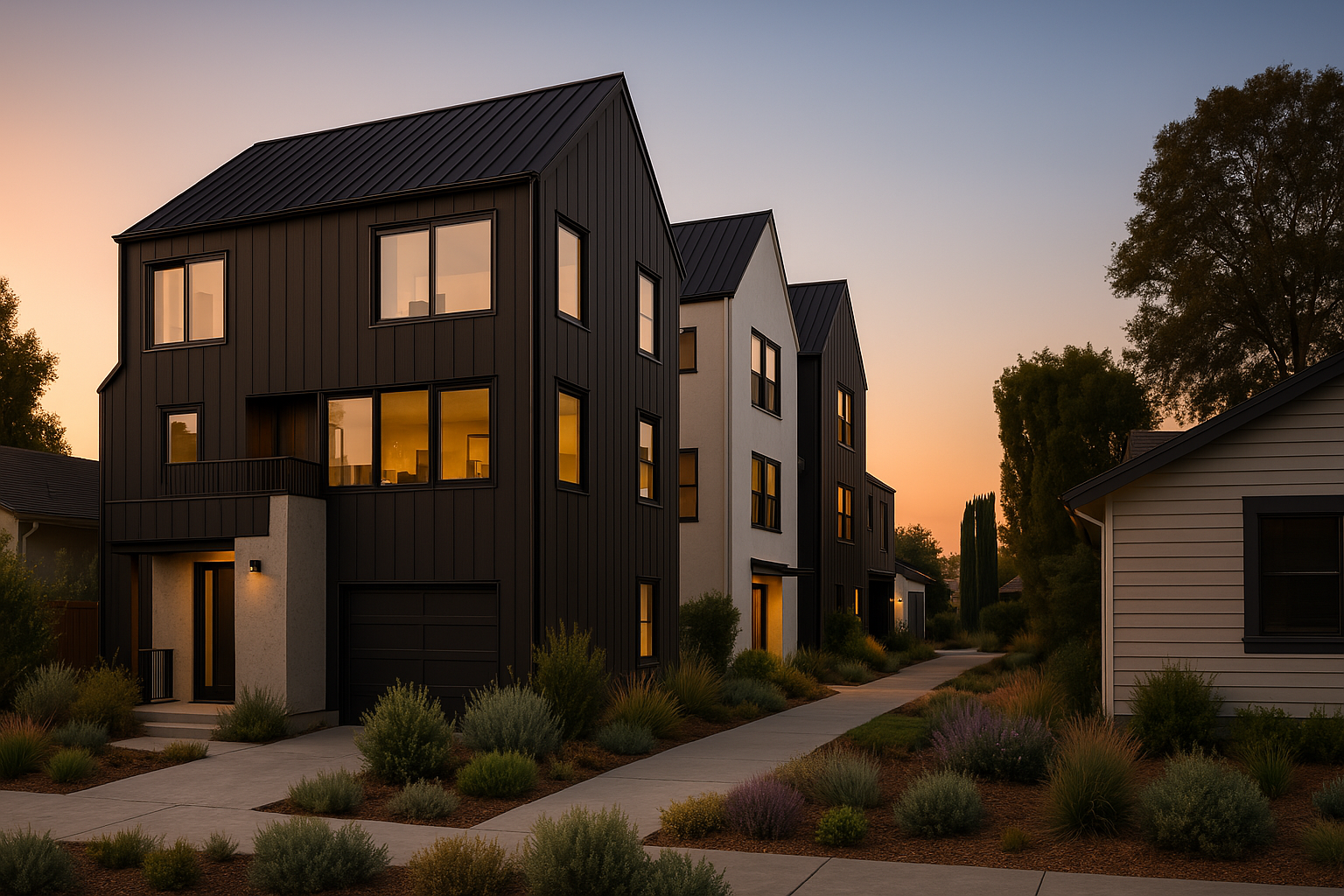
California has a homeownership crisis. The state has the third-highest median home price in the country, and homeownership rates — particularly for Black and Latino families — lag far behind national averages. The gap between California's housing needs and available supply has pushed the modest goal of owning a home further out of reach for millions of working families.
The Legislature's response: the Starter Home Revitalization Act. Originally passed as SB 684 in 2023 and expanded by SB 1123 in 2024, this framework creates a ministerial pathway for small lot subdivisions and starter home developments. For developers, it represents one of the most significant opportunities for by-right housing production in California — if you understand the requirements.
What the Starter Home Act Does
At its core, SB 684 requires local agencies to ministerially approve — without discretionary review or a hearing — parcel maps and housing development projects that meet specified criteria. This is a significant shift from traditional subdivision approvals, which typically involve discretionary review, public hearings, CEQA analysis, and lengthy entitlement timelines.
The law creates two parallel streamlined processes:
• Subdivision Approval: Ministerial review of parcel maps or tentative/final maps for qualifying subdivisions
• Housing Development Approval: Ministerial review of housing development applications on lots subdivided under the act
Together, these processes allow a developer to subdivide a qualifying lot and build up to 10 starter homes with a 60-day approval timeline and no discretionary review.
SB 1123: Expanding the Framework
SB 1123, which took effect July 1, 2025, significantly expanded the original SB 684 framework:
Single-Family Zoned Land Now Eligible
The original SB 684 only applied to lots zoned for multifamily residential use. SB 1123 extends eligibility to vacant lots zoned for single-family residential development, subject to additional requirements:
• Size Limit: Vacant single-family lots must be no larger than 1.5 acres (vs. 5 acres for multifamily)
• Minimum Parcel Size: Newly created parcels on single-family zoned land must be at least 1,200 SF (vs. 600 SF for multifamily)
• Height: Local agencies may impose existing zoning height limits on single-family zoned lots
• Vacant Requirement: The lot must be vacant — no permanent structures (abandoned and uninhabitable structures excepted)
Reduced Density Threshold
SB 1123 reduced the minimum density requirement for projects not identified in the housing element. Under the original SB 684, projects had to achieve 100% of maximum allowable density. Under SB 1123, projects must achieve at least 66% of either:
• Maximum allowable residential density per local zoning, OR
• Applicable residential density per Government Code Section 65583.2(c)(3)(B)
...whichever is greater.
This change gives developers more flexibility in unit mix and design while still ensuring meaningful density.
Tenancy in Common Added
SB 1123 added tenancy in common (TIC) as an eligible ownership structure, joining fee simple, common interest developments, housing cooperatives, and community land trusts. This opens additional financing and ownership models for starter home projects.
Frontage Requirements Waived
The original act waived minimum parcel size, width, depth, and dimension requirements. SB 1123 adds frontage to this list, removing another potential barrier to efficient small lot designs.
ADU/JADU Clarification
SB 1123 clarifies that if a local agency permits ADUs or JADUs on parcels created under the act, those units do not count toward the 10-unit maximum. This allows developers to add accessory units beyond the base development program where local rules allow.
Qualifying Site Requirements
To qualify for ministerial approval under SB 684/SB 1123, a subdivision must meet all of the following:
Subdivision Parameters
• Parcel Count: 10 or fewer parcels
• Unit Count: 10 or fewer residential units (excluding ADUs/JADUs if permitted)
• Lot Size: 5 acres or less (multifamily) or 1.5 acres or less (single-family)
• Minimum Parcel Size: 600 SF (multifamily) or 1,200 SF (single-family), unless local ordinance allows smaller
Location Requirements
• Zoning: Multifamily residential OR vacant single-family residential
• Urban Location: Within an incorporated city with urbanized area, or within urbanized area/urban cluster in a county over 600,000 population
• Surrounded by Urban Uses: Substantially surrounded by qualified urban uses
• Public Utilities: Must be served by public water and municipal sewer
Site Exclusions
The following sites are NOT eligible:
• Prime farmland or farmland of statewide importance
• Wetlands
• High or very high fire hazard severity zones
• Hazardous waste sites (with exceptions for remediated sites)
• Earthquake fault zones (unless seismic standards met)
• 100-year flood zones (unless FEMA requirements met)
• Regulatory floodways (unless no-rise certification obtained)
• Conservation lands and protected habitat
• Sites with existing tenants in past 5 years
• Sites where Ellis Act rights exercised in past 15 years
Development Standards
Local agencies may impose objective zoning, subdivision, and design standards that do not conflict with the act. However, the following standards are prohibited:
• Standards that physically preclude development at densities specified in Government Code 65583.2(c)(3)(B)
• Requirements that apply solely because the project uses this streamlined pathway
• Setbacks between units beyond California Building Code requirements
• Requirements for enclosed or covered parking
• Side/rear setbacks inconsistent with SB 9 (65852.21) standards
• Parking requirements inconsistent with SB 9 standards
• FAR below 1.0 for 3-7 unit projects
• FAR below 1.25 for 8-10 unit projects
Unit Size
The average total habitable floor area across all units cannot exceed 1,750 net habitable square feet. This keeps the focus on starter homes rather than luxury product.
The Approval Process
The act imposes strict timelines on local agencies:
• 60-Day Deadline: Local agencies must approve or deny a completed application within 60 days
• Deemed Approved: If no action within 60 days, the application is automatically approved
• Written Denial: If denied, the agency must provide written comments identifying deficiencies and remedies within 60 days
• Limited Denial Basis: Agencies can only deny projects that would have a specific, adverse impact on public health and safety with no feasible mitigation
Building Permits During Subdivision
A unique feature of SB 684 allows developers to obtain building permits before the final map is recorded:
• After Tentative Map Approval: Local agencies must issue building permits once tentative map is approved and building permit application is complete
• Recorded Covenant: Agency may require a recorded covenant stating certificate of occupancy won't issue until final map records
• Security: Agency may require security (up to 300% of improvement costs) to ensure completion
This allows construction to proceed in parallel with final map processing, significantly compressing project timelines.
What's NOT Required
Projects under the Starter Home Act are exempt from:
• CEQA: Ministerial approvals are categorically exempt from environmental review
• Discretionary Review: No planning commission hearings, no city council approvals
• Minimum Lot Dimensions: No minimum size, width, depth, frontage, or dimension requirements beyond the statutory minimums
• HOA Formation: No requirement to form a homeowners association (though common area maintenance mechanisms may be required)
• ADU/JADU Requirements: Local agencies are not required to permit ADUs/JADUs on parcels created under the act
• Urban Lot Splits: SB 9 lot splits do not apply to parcels created under this act
Ownership Structures
The act permits five ownership structures for starter home developments:
1. Fee Simple: Traditional individual lot ownership
2. Common Interest Development: Condominiums, planned developments, community apartments
3. Housing Cooperative: Cooperative ownership as defined in Civil Code Section 817
4. Community Land Trust: Nonprofit 501(c)(3) maintaining permanently affordable housing with 99-year ground leases
5. Tenancy in Common: Shared ownership as described in Civil Code Section 685 (added by SB 1123)
This flexibility allows developers and mission-driven organizations to structure projects for different buyer profiles and financing programs.
Strategic Considerations for Developers
Site Selection
The eligibility requirements create a specific site profile:
• Target Zones: Multifamily zones (any size up to 5 acres) or vacant single-family (up to 1.5 acres)
• Avoid: Fire hazard zones, flood zones, sites with recent tenants, Ellis Act properties
• Confirm: Public water and sewer availability, urban location criteria
Unit Mix and Sizing
• Average Unit Size: Stay under 1,750 SF average — this allows some larger units if balanced by smaller ones
• Unit Count: Maximum 10 units (plus ADUs/JADUs where permitted)
• Density: Must achieve at least 66% of maximum allowable or default density
Design Efficiency
• Parking: Cannot require covered/enclosed parking; SB 9 parking standards apply
• Setbacks: Only Building Code setbacks between units; SB 9 standards for side/rear from original lot line
• FAR: Minimum 1.0 (3-7 units) or 1.25 (8-10 units) — design to meet or exceed
Timeline Optimization
• 60-Day Track: Submit complete applications to start the 60-day clock
• Parallel Processing: Use building permit provision to start construction before final map
• No CEQA: Factor in time savings from ministerial review
Comparison: Starter Home Act vs. Other Streamlined Pathways
• vs. SB 9: SB 9 is limited to 2 units on single-family lots with urban lot split. Starter Home Act allows up to 10 units on larger lots with full subdivision.
• vs. SB 35: SB 35 requires affordability commitments and labor standards. Starter Home Act has no affordability requirement (beyond inclusionary compliance) for market-rate projects.
• vs. Density Bonus: Density bonus requires affordable units for bonuses. Starter Home Act provides streamlining without affordability requirements.
• vs. TOC: TOC requires transit proximity and affordable units. Starter Home Act has different eligibility criteria.
The Starter Home Act fills a specific niche: ministerial approval for small-scale, for-sale housing without mandatory affordability requirements or labor standards.
The Bottom Line
SB 684 and SB 1123 represent a significant opportunity for developers focused on entry-level homeownership product. The combination of ministerial approval, 60-day timelines, CEQA exemption, and flexible design standards creates a pathway for efficient small lot development that was previously unavailable in California.
The key constraints — 10-unit maximum, 1,750 SF average unit size, site eligibility requirements — define a specific product type: compact starter homes on small lots. For developers with the right sites and the right product, this framework offers a fast track to entitled, by-right housing production.
As with any streamlined pathway, success depends on understanding the requirements in detail and designing projects that fit cleanly within the statutory framework. The 60-day deemed-approved provision gives developers significant leverage — but only if the application is truly complete and compliant.
For more on California's evolving housing legislation, see our coverage of CEQA Reform: What AB 130 and SB 131 Mean for LA Developers.